

EU PPWR: The next step for fruit labels


The Packaging and Packaging Waste Regulation (PPWR) now applies across the EU. For fruit and vegetable labels, the next key date is 12 February 2028. This update explains the requirement and how to prepare.
Sinclair supports the move toward improved packaging circularity. This update reflects the latest European Commission guidance, PPWR legislation, and relevant industry guidance from Freshfel Europe and Packaging Europe.
PPWR covers many types of packaging. This update focuses on Article 9 because it applies to labels attached directly to fruit and vegetables.
From 12 February 2028, Article 9 requires labels attached directly to fruit and vegetables placed on the EU market to be compostable under industrially controlled conditions. Customers should now identify affected labels, review their specifications, and gather the supporting information needed before the deadline.
Where are we now?
Freshfel Europe has been closely involved in discussions around PPWR and the practical needs of fresh produce supply chains. Freshfel has supported the move toward industrially compostable fresh produce labels while calling for packaging rules that are sustainable, harmonized, and workable.
PPWR: The dates to remember
| Date | Description |
| 11 February 2025 | PPWR entered into force |
| 12 August 2026 | PPWR began applying generally across the EU |
| 12 February 2028 | Key fruit-label date: fruit labels attached directly to fruit and vegetables placed on the EU market must meet Article 9 compostability requirements. |
| From 2030 | Other PPWR measures continue to phase in. They may affect customers’ wider packaging, but they are outside the main scope of this fruit-label update. |
What Article 9 means for fruit labels
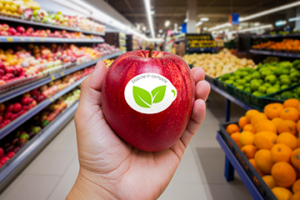 The requirement concerns what happens to a fruit label at the end of its useful life. Until new harmonized standards are published, EN 13432 can be used as guidance for industrial compostability. EU Member States may also require compatibility with a home-composting standard. The detailed application of these requirements is still developing, so businesses should check the requirements for each market.
In practical terms, fruit labels used on produce sold in or destined for the EU will need to be industrially compostable by 12 February 2028. Sinclair T55 is certified for both industrial and home composting, providing supporting evidence for customers as they assess requirements in each EU market.
Why start preparing for PPWR now?
Changing a fruit-label specification takes time and must be coordinated with seasonal operations and the wider supply chain. To prepare for the deadline while minimizing disruption, we recommend the following steps:
- identify labels used on fruit and vegetables that will be placed on the EU market
- confirm with your local Sinclair Customer Service team which labels are affected
- review the relevant label specifications and supporting information
- request Sinclair T55 artwork for each affected label and complete the approval process
- plan the transition to align with seasonal operations and supply-chain requirements
If you use fruit labels on fresh produce sold in or destined for the EU, contact your local Sinclair Customer Service team to review your current requirements and plan the transition.
Preparing for February 2028
The Article 9 requirement is established, and 12 February 2028 is the key date for fruit labels placed directly on fruit and vegetables in the EU to become industrially compostable. Reviewing label requirements early will help businesses prepare for PPWR compliance.
Talk to our team about preparing your fruit labels for PPWR compliance
Frequently Asked Questions
Article 12 labeling requirements are not yet finalized. Sinclair recommends using a clear, simple, and specific message that helps shoppers choose the correct disposal method. Any compostability claim should be supported by credible evidence. Because fruit labels provide limited space, the final wording will depend on further regulatory clarification. Sinclair has consulted TÜV AUSTRIA, which certifies Sinclair T55 for both industrial and home composting. Its guidance favors a short, actionable call to action. Contact your local Sinclair Customer Service team before changing label artwork. Suggested calls to action include:
- Dispose in compost
- Compost me
- Compostable
- Industrially compostable
- Home compostable
- OK compost HOME S0728
- OK compost INDUSTRIAL S0728
Avoid using “home compostable” unless the label meets the relevant home-composting requirements for the market where it is sold. The European Commission notes that home-compostability can depend on Member State requirements.
Yes, in due course. PPWR introduces harmonized consumer labeling for compostable packaging under Article 12. From 12 August 2028, or 24 months after the relevant implementing acts come into force (whichever is later), packaging covered by Article 9, including fruit labels, will need to indicate that the material is compostable, that it is not suitable for home composting, and that compostable packaging should not be discarded in nature. Packaging manufactured or imported before that date can continue to be made available for up to three years. The EU is still finalizing the detailed labeling specifications, so check the latest requirements before deciding what information to add to your fruit labels.
Industrial compostability is the EU-wide requirement for the fruit labels covered by Article 9. Member States may also require compatibility with home-composting standards. The EU standards framework is still developing, so businesses should check the requirements in each market where their produce is sold
EN 13432 is the established European standard used to assess whether packaging is suitable for industrial composting. It sets criteria for how packaging behaves and breaks down under controlled composting conditions, and it is the basis for industrial compostability certification by certifying bodies such as TÜV AUSTRIA and DIN CERTCO, both of which certify Sinclair products.
It is particularly relevant to Article 9, but there is an important qualification. The European Commission says EN 13432 can currently be used as guidance while new harmonized standards requested under Article 9 are being developed. A presumption of conformity will only arise once the relevant harmonized standards are formally listed in the Official Journal of the European Union.
PPWR Article 9 is about the compostability of the fruit label itself. The on-label information requirements come from Article 12 (see above) and will apply later.
No. PPWR covers packaging much more broadly. This article deliberately focuses on fruit labels attached directly to fruit and vegetables because that is the area most relevant to Sinclair and our customers
In simple terms, it refers to packaging being made available for the first time on the EU market in the course of a commercial activity. The exact responsibility can depend on how a product and its packaging move through the supply chain.
PPWR gives “manufacturer” a specific legal meaning. In general, it is the business that manufactures packaging, or has packaging designed or manufactured, and markets it under its own name or trademark. The Regulation and European Commission guidance include further detail and exceptions, so businesses should check which role applies to them.
“Producer” is another defined PPWR role and is mainly relevant to extended producer responsibility obligations in a particular Member State. A producer is not necessarily the same business as the packaging manufacturer. Businesses should confirm their role in each market where they operate.
No. 12 August 2026 is the general PPWR application date. The specific Article 9 compostability requirement for fruit labels attached directly to fruit and vegetables applies from 12 February 2028.
No. The Article 9 requirement discussed here is specifically for fruit labels attached directly to fruit and vegetables. Other labels and packaging may be covered by different PPWR requirements.
Start by asking the label supplier what information supports the compostability of the complete label specification. The applicable standards and supporting documentation should be checked as the 2028 deadline approaches and as EU guidance develops

